What actually drives the reorders
Squishies do not win on novelty alone. A wholesale buyer repeats an order when three things are true: the item feels good in the hand, it photographs or videos well enough to sell online, and its unit cost leaves margin for the channel. In Chenghai, the densest toy manufacturing cluster in the world, those three conditions show up in very specific shapes and materials.
Across the 20-plus years our desk has spent exporting toys, the categories that survive a trend are the ones with a real emotional use - stress relief, fidgeting, collecting - not just a viral moment. "Slow-rising" PU foam and the firmer, stretchier TPR/mochi textures both keep working because they are satisfying to handle over and over.
The shapes with staying power
Food-shaped squishies lead the category, and within food, the familiar and the cute beat the exotic. Expect these to stay on reorder lists:
- Slow-rising food shapes - baozi buns, steamed buns, dumplings and maltose cheese sticks. The realistic dough texture and slow rebound are the whole selling point.
- Mochi / squeeze cubes - small, matte, soft cubes that are cheap to ship and easy to bundle into multi-packs.
- Scented mini-buns and keychains - small units that double as bag charms, popular with the tween and gift-shop crowd.
- Surprise and advent formats - 24-day calendars and mystery packs turn a low-price toy into a gifting event and lift average order value.
| Format | Typical feel | Best fit |
|---|---|---|
| Slow-rising PU food | Soft, slow rebound | Retail shelves, gift shops, bundles |
| Mochi / TPR cube | Firm, stretchy | Party favors, bundles, vending |
| Scented mini-bun | Slow rebound + scent | Checkout impulse, keychain lines |
| Surprise calendar | Mixed textures | Seasonal gifting, Amazon bundles |
Channel by channel: match SKU to venue
The same squishy can be a hit in one venue and a miss in another. Match the SKU to how it will actually be sold.
Amazon sellers win with branded, packaged multi-packs and themed bundles (mini food set, unicorn set). Listing quality, unit labels and FBA-ready cartons matter more than the single-unit price.
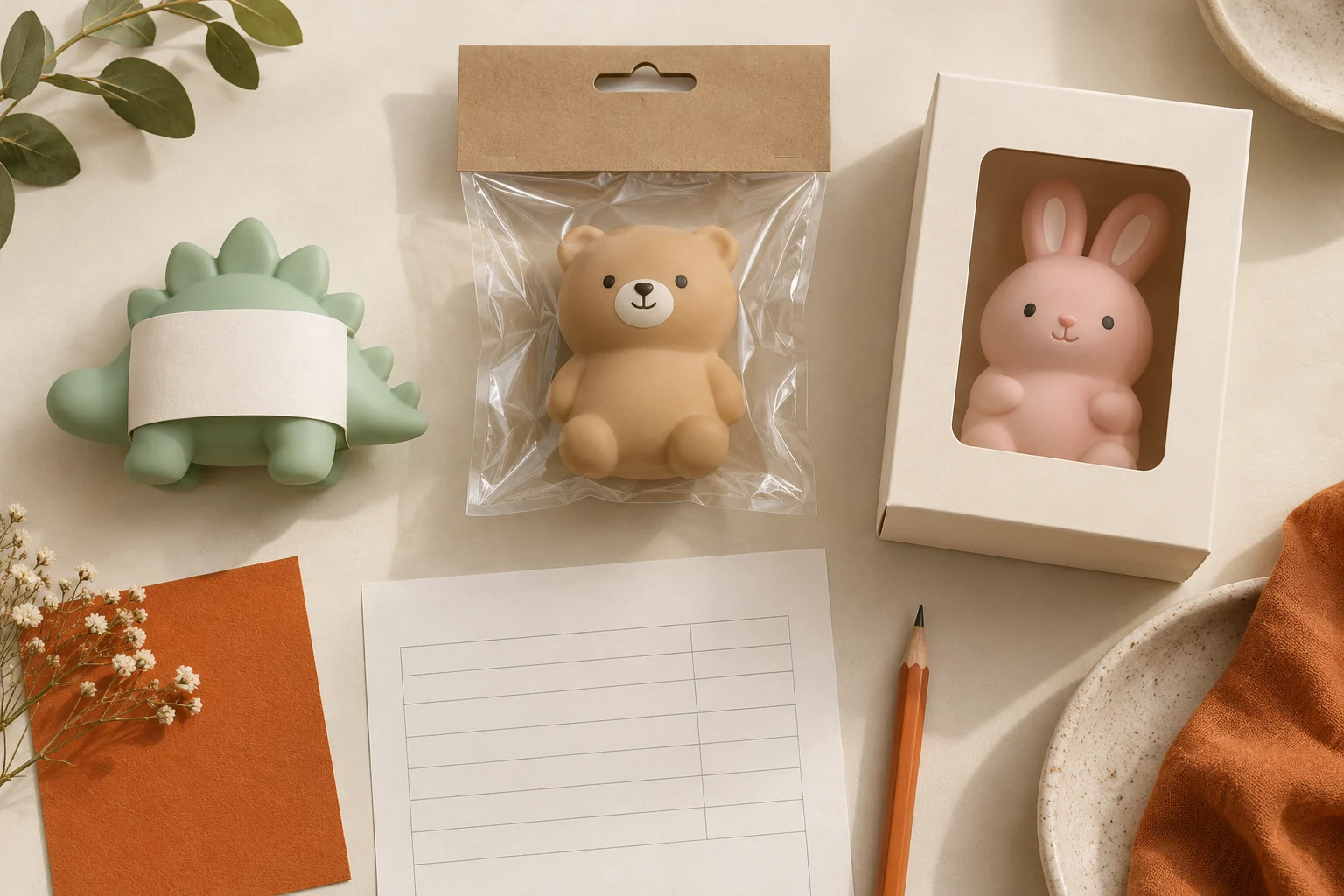
Shopify and independent brands lean into the stress-relief and desk-toy narrative. A small private-label run with your own hang tag or box turns a commodity item into your brand, and low per-SKU MOQ (120-600 pieces for eligible projects) lets you test without a warehouse full of stock.
Gift shops and tourist venues buy individual display pieces - the baozi in its steamer, the scented bun. They care about presentation and price point, not bundles.
Claw-machine and vending operators buy by case pack and size. A squishy has to fit the claw and survive being grabbed repeatedly; oversized or oddly shaped items disappoint players and operators alike.
How to test a trend without overbuying
Trends are easy to overestimate from short video. The way to de-risk one is to treat the first order as a sample of the market, not a bet on a season. Start with a few proven core shapes, buy small, and consolidate several SKUs into one shipment so freight cost is shared across the assortment. Approve a physical sample for rebound speed, scent level and finish before production. If a shape sells through in the test, the repeat order is simple because the supplier already has the tooling in place.
Stacking a range that pays its freight
The buyers who keep reordering are rarely betting on a single hero SKU. They build a range around one trusted format and layer in price points. A strong starter mix might pair a display-boxed hero squishy (the piece people photograph), a half-dozen mini mochi pieces (the impulse and bundle filler) and one seasonal or novelty format (the reason repeat customers come back to look). Because every SKU in the range can ride the same consolidated container, the freight cost across the mix stays low enough that the low-priced fillers still make margin. That is the practical advantage of cluster sourcing: variety does not have to multiply your logistics.
Watch the price band as you build. Hero pieces carry the perception, but the fillers carry the volume and the repeat order rate. If your first order leans too heavily toward the premium end, restocking looks expensive; if it leans too far toward fillers, the range lacks a face. Balance the mix before you place the order, not after it sells.
Watch-outs: scent, feel and compliance
A "slow-rising" claim is only as good as the actual foam. Some cheap pieces rebound in under a second or carry a strong chemical scent that customers return. Sample first. On compliance, exported squishies are commonly tested to EN71 for the EU, ASTM F963 and CPSIA for the US, with a Children's Product Certificate (CPC) where required. Documents are matched SKU by SKU against the real material and age grade - a generic "CE" mark is not a substitute.
One more rule that quietly protects brands: do not reproduce licensed characters. Trendy as they look, third-party IP is a customs and Amazon-blocking risk. Build your own character set or stick to original food and animal shapes.
Frequently asked questions
What squishy toys are selling best in 2026?
Slow-rising food shapes such as baozi buns, dumplings and maltose cheese sticks, mochi-style squeeze cubes, scented mini-bun keychains and 24-day surprise calendars are the most reordered wholesale categories in 2026.
Are squishy toys still a good product to resell?
Yes. Squishies remain a low-cost, highly giftable impulse item with strong re-order rates, especially as party favors, claw-machine prizes and checkout add-ons, provided the rebound feel and packaging meet the target market's safety rules.
What is the minimum order quantity for custom squishies?
Private-label packaging on existing designs commonly starts at 120 to 600 pieces per SKU for eligible projects; a fully custom mold or new tooling carries its own higher minimum and tooling cost, quoted per project.
Do squishy toys have to comply with safety standards?
Yes. Exported squishies are commonly tested to EN71 (EU), ASTM F963 (US) and CPSIA requirements, with CPC documentation for the US. Documents are matched SKU by SKU against the actual material and age grade.
How do I pick squishies that will not sit in stock?
Start with proven core shapes, buy small first, sample before production, group several SKUs into one consolidated shipment, and match each SKU to a real selling channel rather than guessing from social media trends.
Shortlist current squishy SKUs ↗
Buying guidance for B2B wholesale. Prices, MOQs, materials and compliance documents must be confirmed for the actual SKU, destination market and order volume.