From the sourcing desk
How to Schedule a Small-Batch Toy Launch by Approval Gates
Work backward through sample, artwork, print, inspection and handover approvals using a fillable gate map, date calculation and escalation example.
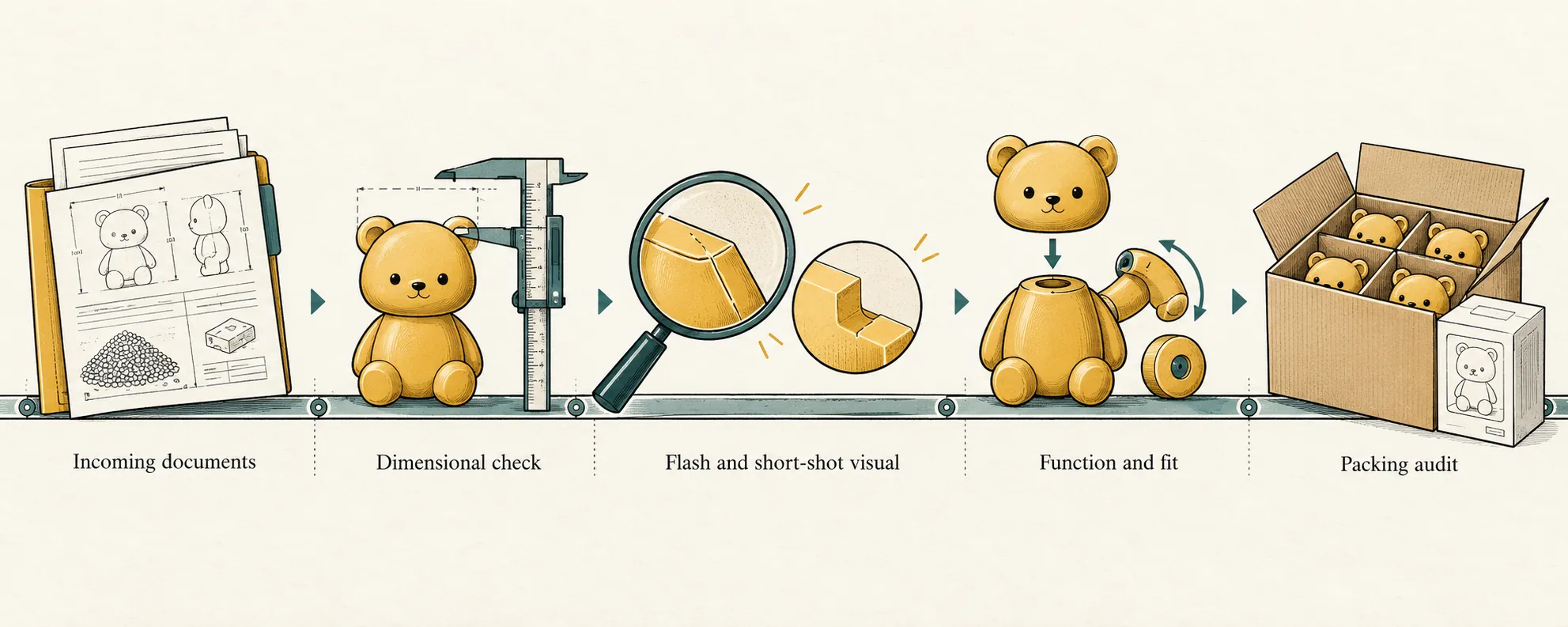
Schedule a small-batch toy brand launch backward from an agreed handover milestone, with separate submission and approval dates for samples, artwork, print, inspection and handover. Treat the supplier’s factory date as a milestone to validate against those dependencies—not as the schedule itself. Reserve preparation, review and production time explicitly; if unfinished work would need to start in the past, escalate the conflict before accepting the launch commitment. There is no universal lead time for this plan.
Why is a promised factory date not enough to plan a toy launch?
A promised factory date does not tell you when the buyer must submit complete files, approve a sample or resolve inspection findings. Those decisions need their own owners and deadlines.
Start by defining the endpoint: authorization to hand over goods, or the physical handover itself. Neither is the same as inventory becoming available on Amazon, Shopify or a distributor’s shelf. If the launch date is your starting point, have the downstream owner confirm the interval needed after physical handover before calculating the approval schedule.
Then protect reviewer time. The transferable scheduling principle is to reserve the reviewer’s full working-day allowance before setting the submission deadline, as described in the ONES scheduling guide. Its engineering examples are not toy-production lead times.
What must sample, artwork, print, inspection and handover approvals release?
Each gate should release a defined next activity against an identified revision, rather than simply record that someone said “approved.” Use the following commercial release structure and assign named people to the roles.
Before dating these gates, confirm the product selection, sourcing brief and itemized quote. Identify any testing or technical assessment needed for the intended market as a separate prerequisite with its own owner and agreed duration; a commercial sample approval or inspection does not replace that work.
| Sample approval | Submit the identified physical sample and specification revision, including agreed packaging interfaces. The buyer’s product approver records acceptance, rejection or conditions against that reference. Release product-dependent artwork finalization and production preparation only within the approved scope. Keep physical sample receipt separate from the approval date. |
|---|---|
| Artwork approval | Submit the complete packaging artwork revision, including copy and product identification for the intended market. The buyer’s designated artwork approver signs off that exact revision. Draft layouts can run alongside sample work, but final approval must account for any sample-dependent dimensions or product details. |
| Print approval | Submit the agreed printer proof or physical print sample, identified against the approved artwork revision. The buyer’s packaging approver checks the agreed print reference and records the release decision. This gate authorizes the corresponding print run; artwork approval alone should not be treated as print approval. |
| Inspection disposition | Submit the inspection report for the identified lot against the approved sample, specification and inspection plan. The inspector reports observations; the buyer’s quality approver decides release, hold, rework or reinspection. State major and minor defect limits in the lot’s inspection plan instead of silently adopting factory defaults. |
| Handover authorization | Submit the final handover package identifying the lot, quantities, packing details, inspection disposition and receiving party. The buyer’s shipment approver authorizes handover against that package revision. Record the receiving party’s actual handover acknowledgment separately: authorization is not evidence that the goods have physically changed hands. |
How do you fill the backward-scheduled gate table?
Set the latest acceptable approval date for the final gate, then subtract review time to find its submission deadline and preparation time to find its required start. Repeat backward through the dependencies.
Use these relationships: submission deadline = approval deadline minus review allowance; preparation start = submission deadline minus preparation duration and any separately reserved contingency. An upstream approval must occur no later than the start of the activity it releases. Where several approvals feed one activity, all must be available by that start.
Do not skip the work between gates. Put printing, product manufacture, packing and readiness for inspection into explicit activity intervals, using estimates confirmed by their owners. Inspection report submission is not the inspection appointment: allow for conducting the inspection and preparing the report before buyer review begins.
Copy the fields below into your schedule. Use one agreed working calendar, including relevant supplier and reviewer closures, and specify the deadline time zone.
| Schedule identity and interval inputs | Product/variant: [fill in]; sample reference: [fill in]; specification revision: [fill in]; artwork revision: [fill in]; lot/order reference: [fill in]; schedule revision/date: [fill in]; schedule owner: [fill in]. Record owner-agreed preparation durations, production/packing intervals and visible contingency separately. |
|---|---|
| Sample approval dates | Preparation start: [date]; complete sample submission/receipt due: [date]; review allowance: [working days]; approval due: [date]; approver: [name]; dependency: approved brief and selected product; status: [fill in]. |
| Artwork approval dates | Preparation start: [date]; complete artwork submission due: [date]; review allowance: [working days]; approval due: [date]; approver: [name]; dependency: sample-approved product and packaging details needed for final artwork; status: [fill in]. |
| Print approval dates | Proof preparation start: [date]; proof submission due: [date]; review allowance: [working days]; approval due: [date]; approver: [name]; dependency: approved artwork revision; status: [fill in]. |
| Inspection disposition dates | Inspection/report preparation start: [date]; complete report submission due: [date]; review allowance: [working days]; disposition due: [date]; approver: [name]; dependency: lot ready under the agreed inspection plan after relevant production and packing work; status: [fill in]. |
| Handover authorization dates | Package preparation start: [date]; complete handover package submission due: [date]; review allowance: [working days]; authorization due: [date]; approver: [name]; dependency: inspection disposition and closure of release-blocking conditions; physical handover target: [date]; status: [fill in]. |
| Decision and closure record—complete for every gate | Actual submission date: [fill in]; actual approval/disposition date: [fill in]; reference reviewed: [fill in]; specified acceptance target versus observed result: [fill in]; decision and conditions: [fill in]; responsible approver/date: [fill in]; follow-up owner/due date: [fill in]; closure evidence/date: [fill in]. Record actual physical handover and receiving acknowledgment at the final gate. |
What does a worked backward schedule look like?
A backward calculation can reveal an overdue sample deadline even when the handover authorization date is still ahead.
The entire example below is illustrative: every date, duration and dependency interval is a scenario assumption, not a recommended toy lead time. Assume handover authorization is due November 20, 2026; work occurs Monday through Friday with no holiday closures; approvals release dependent work without an additional lag; and all packages are complete at submission.
Further illustrative assumptions: handover preparation takes one working day plus one separate contingency day; inspection and report preparation take two working days; the interval from print approval to inspection readiness takes five working days; print-proof preparation takes two working days; final artwork preparation takes two working days; and sample preparation takes three working days. Review allowances appear in each row. Rework is not included.
| Illustrative sample gate | Preparation start: October 20, 2026. Submission: October 23. Review allowance: 2 working days. Approval: October 27, releasing final artwork preparation. |
|---|---|
| Illustrative artwork gate | Preparation start: October 27, 2026. Submission: October 29. Review allowance: 2 working days. Approval: November 2, releasing print-proof preparation. |
| Illustrative print gate | Proof preparation start: November 2, 2026. Submission: November 4. Review allowance: 1 working day. Approval: November 5. The assumed 5-working-day production/packing interval then reaches inspection readiness on November 12. |
| Illustrative inspection gate | Inspection/report preparation start: November 12, 2026. Report submission: November 16. Review allowance: 1 working day. Disposition: November 17, releasing final handover-package preparation. |
| Illustrative handover gate | Package preparation starts November 17, 2026, with 1 working day for preparation and 1 separate working day of contingency before submission on November 19. Review allowance: 1 working day. Authorization: November 20. Physical handover remains a separately confirmed milestone. |
What should you do when the required start date has already passed?
Escalate unfinished critical-path work to the buyer’s launch decision-maker; do not make the schedule appear feasible by silently deleting review time.
In the illustrative schedule, suppose that as of October 28, 2026, sample preparation has not started. The October 20 start and October 27 sample approval are already past. The original schedule is therefore infeasible under its stated assumptions. If work has actually been completed, record that evidence first—a past planned start alone does not prove the remaining schedule is impossible.
Present a decision with consequences: reduce launch scope by deferring an optional packaging variant; move independent drafting or document preparation into parallel work; add a qualified reviewer or preparation resource where that genuinely changes the estimate; or move the handover target. Product and quality owners must confirm that any scope or sequencing change preserves the necessary release conditions. The brand owner or designated launch lead approves the resulting commercial trade-off.
Protect contingency before a vulnerable submission or handoff, rather than disguising it inside the reviewer’s allowance. Early escalation and visible contingency are also recommended in the ONES scheduling guide.
Issue a revised schedule with the chosen option, changed dates, responsible owners and unresolved conditions. Keep the original target, current forecast and actual observations distinct. A gate record supports traceability; it does not prevent a later delay or reveal an undisclosed product change by itself.
What should you send for sample and packaging coordination?
Send your completed gate map, sample reference, artwork revision and unresolved date conflicts to your sourcing coordinator for a sample, packaging and QC schedule review. Request confirmation of each preparation interval, submission deadline and named approver before committing to the handover target.