From the sourcing desk
Toy Packaging: Which Sample Approval Releases Production?
Separate digital proof, printed proof, fit sample and packed-reference approvals, with inspection steps and a four-row approval record.
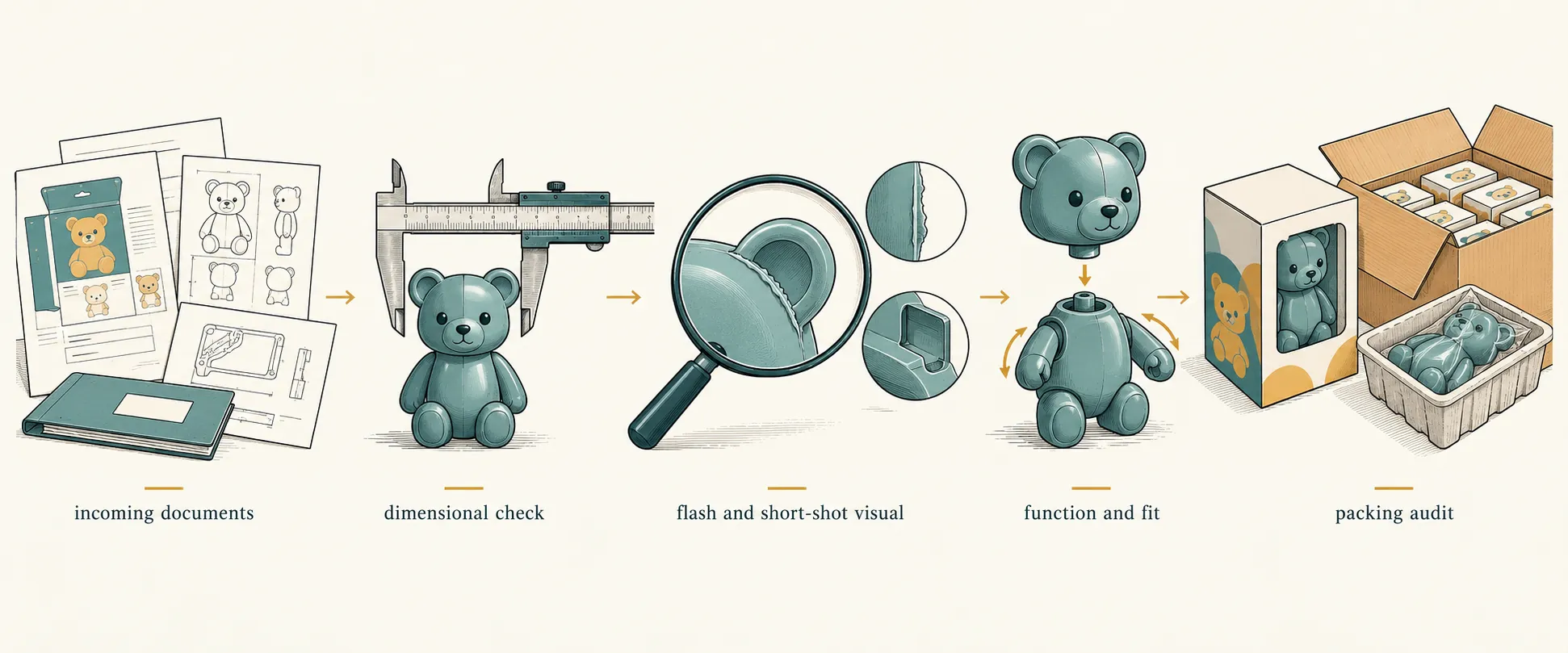
Packaging mockup approval confirms only the attributes it represents; it is not production sample approval. For toy packaging sample approval, sign off the digital proof, printed proof, physical fit sample and packed reference separately, each against an identified revision. Compare the first physical toy sample with the agreed written specification and design requirements before designating it an approved production reference. Release bulk production only after the packed, production-representative sample is approved and release-blocking questions are closed.
For an Amazon or Shopify brand, a convincing package image can settle a design discussion without answering whether the actual toy fits, the selected stock folds correctly, or the final printing and closure processes produce the agreed result. Keep those decisions separate—even if one person signs every approval.
What Can Each Packaging Artifact Approve?
Use the digital proof for content, the printed proof for represented print attributes, the physical fit sample for structure, and the packed reference for the combined production-representative result. A rendered mockup is a concept image, not a substitute for a controlled digital proof built on the converter’s structural file. Obtain that file and its material, printing and finishing specifications before placing artwork. AI Packaging Mockup vs. Print-Ready Packaging
The approval limits below are purchasing controls, not a certification scheme. A digital proof can show nominal dimensions without verifying the assembled package; a production-method sample still cannot establish consistency across every bulk unit or prove transport performance. Packaging Sample Guide
| Digital proof — Is the controlled artwork correct? | Compare with the approved copy master, product identity, artwork revision, converter’s dieline and print specifications. Approve spelling, language version, panel direction, artwork placement, nominal dimensions and barcode data placement. Do not approve assembled dimensions, physical fit, board thickness, material feel, actual print color, finish or closure behavior. Failure signal: wrong product copy, an obsolete dieline or content crossing a fold or glue area. Next decision: correct and reissue the proof before advancing. Recommended signer: the buyer’s designated artwork/content approver. |
|---|---|
| Printed proof — What does this printing route actually represent? | Inspect physical artwork scale, placement, legibility and general printed appearance against the approved artwork and agreed print targets. Record the substrate, printing method and finishes actually used. Approve only the attributes those materials and methods represent; substitute stock or a different print route does not establish the final commercial result. Failure signal: shifted artwork, unreadable copy, an unacceptable visual result or an unexplained process substitution. Next decision: correct the print issue or obtain a representative proof for the unresolved attribute. Recommended signer: the designated brand/print approver. |
| Physical fit sample — Does the structure work with the specified toy? | Compare the assembled sample with the packaging drawing, material specification, insert design and packing instructions, using a toy checked against its own specification. Inspect dimensions, folding, opening, closing, insert layout and product loading. A handmade dummy does not approve final print, color or finishes, and substitute material limits conclusions about production behavior. Failure signal: a bowed panel, trapped component, displaced insert or closure requiring unintended force. Next decision: identify whether the toy, structure or assembly is out of specification, then correct and repeat the affected checks. Recommended signer: the buyer’s packaging or quality approver. |
| Packed reference — Does the specified toy and final package work together? | Inspect a fully packed candidate made with the agreed production-representative materials, printing, finishing and assembly route. Compare it with the written specifications and previously approved revisions. Approve the combined product identity, component count, appearance, fit, closure, labels and workmanship within documented acceptance criteria. Do not treat it as proof of every bulk unit, regulatory safety or distribution performance. Failure signal: a process mismatch, damaged toy finish, missing component or unresolved print, fit or closure deviation. Next decision: hold release, correct and review again; retain the candidate as the approved packed reference only after approval. Recommended signer: the buyer’s authorized procurement/quality release approver. |
When Does a Printed Proof Support Final Color or Seal Approval?
A printed proof supports final approval only for attributes represented by its documented material and production process. A digitally printed presentation on substitute stock can establish visual direction without establishing the result of a different commercial printing route. Record the difference explicitly rather than signing an unrestricted “print approved” note. The flexible-packaging source makes this distinction between intended material, similar stock and simplified substitutes. Digital Proof vs Printed Sample vs Production Sample
For a sealed bag, record seal appearance separately from any agreed performance checks. A neat-looking seal is not a seal-strength or package-integrity result, and those properties require appropriate, separate methods. Apply this check only when the specified toy package uses that construction; do not import pouch requirements into a folding-box review. Packaging Sample Approval Checklist
What Should You Inspect Before Approving the First Physical Toy Sample?
Compare the first physical toy sample with the agreed written specification and design requirements—not with an assumed “golden sample” that has not yet been approved. Inspect the toy before packing, check its fit, then remove it and inspect again for packaging-induced marks or interference. Only after approval should the identified sample become the retained production reference.
The following are practical purchasing checks. Hand inspection does not establish regulatory safety or age suitability; use the applicable specified laboratory tests for safety conclusions.
| Function | Target record: the written function and assembly requirements. Observation: operate the specified features and check that the package or insert does not obstruct them. Failure signal: a required feature does not operate as specified, before or after packing. Next decision: record the affected function and hold product approval until correction and recheck. |
|---|---|
| Materials | Target record: the agreed component and packaging material specifications. Observation: compare identifiable components, substrate type, thickness and material markings where applicable; review supporting material records for properties that cannot be identified visually. Failure signal: a visible or documented mismatch, or an unconfirmed substitution. Next decision: resolve the material identity before approving the affected attribute; appearance alone does not establish composition. |
| Finish and workmanship | Target record: the approved design requirements, finish description and specified visual acceptance criteria. Observation: inspect toy decoration, seams or assembly joints where present, plus print registration, surface finish and contact areas after unpacking. Failure signal: an unacceptable mark, misaligned decoration, glue residue or packaging-induced scuff. Next decision: identify the source and repeat the affected product and packing checks after correction. |
| Dimensions | Target record: the toy drawing, packaging drawing and agreed measurement points. Observation: measure the specified toy features, assembled package and insert locations with suitable measuring tools. Failure signal: a measurement outside the agreed limits or a fit conflict despite nominal dimensions matching. Next decision: check geometry and assembly as well as dimensions; revise the responsible component rather than forcing the fit. |
| Agreed packaging and contents | Target record: the packing instruction, component list and approved artwork. Observation: count the contents; verify orientation, insert engagement, opening, closure, label identity and barcode presentation. Failure signal: missing contents, mixed revisions, an obscured code or a closure that deforms the package or toy. Next decision: correct the packing method or structure and repeat the packed review. |
How Should a Failed Fit Check Change the Approval Decision?
A failed fit check should trigger a comparison of the toy, insert and package against their specified targets before any component is changed.
Illustrative inspection scenario—not a reported customer result: the packing instruction requires the flap to close flat with the toy seated in its insert. During review, the flap closes only while the reviewer presses the toy downward. Record the target as “flap closes flat without compressing the toy,” and the observation as “flap springs open when pressure is removed.” Mark fit approval as held.
Measure the toy at the drawing’s specified points and confirm the insert and dieline revisions. If the toy meets its requirements but the insert holds it too high, correct the insert. If the toy exceeds its specified dimensions, resolve the product discrepancy rather than enlarging the package to conceal it. If both match their drawings, revisit the design clearance or assembly instruction.
Assign the correction to a named owner, review the revised fit sample, and then inspect the corrected production-representative packed candidate. A revised PDF alone cannot close this physical fit failure.
What Should the Four Separate Approval Records Contain?
Create one approval record for each artifact, with the tested revision, specified target, actual observation, decision and unresolved questions visible together. The blank structure below is intended for completion; the scope limits belong in each record even when the same person signs all four.
Keep supporting measurements, relevant reports and photographs with the record. A missing photograph alone does not invalidate a documented review. Identify where the physical or digital reference is retained, and mark or destroy superseded physical samples so they cannot be mistaken for the current standard. Packaging Sample Approval Checklist
| Digital proof approval record | Artifact ID/file: ____; product/model and market version: ____; artwork and dieline revisions tested: ____; specification revision: ____; received/reviewed date: ____; specified targets: ____; observations and review method: ____; what this approval covers: ____; what it does not represent: ____; deviations: ____; decision—approve within scope, conditional or hold: ____; approval conditions: ____; approver and role: ____; decision date: ____; retained file location: ____; open questions: ____; follow-up owner and due date: ____; closure evidence, verifier and date: ____. |
|---|---|
| Printed proof approval record | Artifact/sample ID: ____; product/model and market version: ____; artwork, dieline and print specification revisions tested: ____; actual substrate, print method and finishes: ____; received/reviewed date: ____; specified targets: ____; observations and measurement method: ____; what this approval covers: ____; what it does not represent: ____; deviations: ____; decision—approve within scope, conditional or hold: ____; approval conditions: ____; approver and role: ____; decision date: ____; retained reference location: ____; open questions: ____; follow-up owner and due date: ____; closure evidence, verifier and date: ____. |
| Physical fit sample approval record | Artifact/sample ID: ____; toy sample ID and product specification revision: ____; packaging drawing, dieline and insert revisions tested: ____; actual sample materials: ____; received/reviewed date: ____; specified fit and dimension targets: ____; observations and measurement method: ____; what this approval covers: ____; what it does not represent: ____; deviations: ____; decision—approve within scope, conditional or hold: ____; approval conditions: ____; approver and role: ____; decision date: ____; retained reference location: ____; open questions: ____; follow-up owner and due date: ____; closure evidence, verifier and date: ____. |
| Packed reference approval record | Candidate/reference ID: ____; toy sample ID: ____; product, artwork, dieline, insert and packing instruction revisions tested: ____; actual materials and production route: ____; received/reviewed date: ____; specified targets and acceptable variation: ____; observations and measurement methods: ____; what this approval covers: ____; what it does not represent: ____; deviations: ____; decision—approve within scope, conditional or hold: ____; production-release conditions: ____; authorized approver and role: ____; decision date: ____; retained reference location: ____; open questions: ____; follow-up owner and due date: ____; closure evidence, verifier and date: ____. |
What Happens After a Discrepancy or Revision Change?
Reopen the approval affected by the discrepancy or change, preserve the earlier record, and close the issue with evidence from the corrected revision. Mark or destroy superseded physical samples so they cannot be mistaken for the current approved standard. Write the mismatch as target versus observation, identify which decision is blocked, assign an owner, and specify what must be reviewed again.
For example, changing an insert may reopen fit and packed-reference approval without invalidating unchanged copy approval. A new print route may reopen printed-proof and packed-reference approval. Review the actual impact instead of either carrying every old approval forward or discarding all prior evidence.
A revised quotation also needs this technical check: a different structure, adhesive or printing route can change what the approved sample represents. Price approval is not technical approval. Packaging Sample Approval Checklist
Use conditional approval only to authorize a clearly named next stage. “Layout approved; physical color review pending” can advance print sampling, but it cannot become an unrestricted production release.
When Can You Release Production, and What Does Bulk Inspection Compare?
Release bulk production when the identified packed reference is approved against the current specifications and all conditions affecting product construction, print, fit, contents and closure are closed. Keep any remaining administrative follow-up separate, with an owner and due date; do not let an unresolved technical question disappear under a general “approved” stamp.
Use the identified approved physical reference—not a loose reference photo—for the attributes it represents. Link it to the written specifications, approved artwork, measurement criteria, deviation decisions and change records. The retained sample complements those records; it is not the only valid basis for inspection.
Bulk comparison is the next stage. Check production units against that combined approval package and the agreed inspection plan, including attributes that cannot be established from appearance alone. A production-method sample does not automatically establish order-wide consistency or transport performance. Packaging Sample Guide
Proof review and hand inspection are not independent regulatory approval or safety certification. Keep destination-specific content review and applicable safety evidence separate from these commercial approvals. An approval record provides traceability; it does not by itself reveal an undisclosed material or process change.
What Should You Request for the Next Sample Review?
Request a coordinated sample-and-packaging review using the current toy specification, artwork, dieline, packing instruction and four approval records. Ask the sampling coordinator to identify the candidate packed-reference sample and return a closure record for every production-release condition before requesting your final signoff.