From the sourcing desk
OPP Bag vs Paper Sleeve vs Retail Box: Toy Packing Choice
Compare OPP bag, paper sleeve and retail box for the same toy: visibility, artwork area, protection, assembly and disposal, plus what to quote.
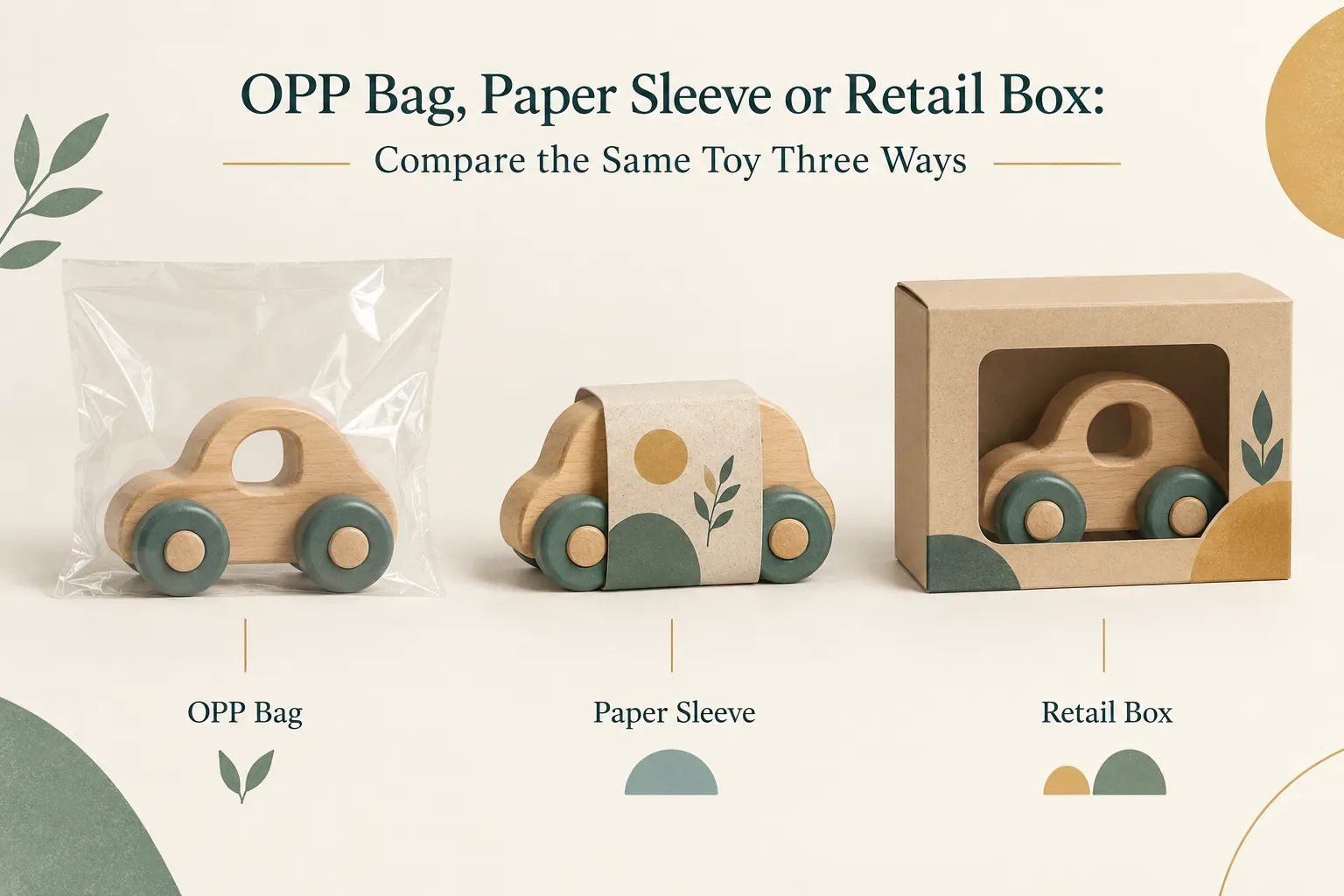
Pick the format by what the toy must survive and what the listing must show, not by unit cost alone. For a low-price educational or fidget toy sold on Amazon or Shopify, an OPP bag wins when the product is already visually self-explanatory and the buyer needs the lowest handling cost; a paper sleeve wins when you need printed brand story and a hang hole but can accept limited protection; a retail box wins when the toy needs structure, stacking, or a shelf presence that a bag cannot deliver. The same physical toy can ship in all three, so the honest comparison isolates format, not product. Every incremental price for printing, inserts or upgraded board is quote-required and depends on artwork area, material and order quantity.
Packaging Decision Matrix for One Toy, Three Formats
| Visibility of the toy itself | OPP bag: highest — clear film shows the product; Paper sleeve: partial — window or open ends only; Retail box: lowest — buyer sees artwork, not the toy |
|---|---|
| Printable artwork area | OPP bag: small, usually a header card or a single printed panel; Paper sleeve: medium, wraps the product with a continuous print surface; Retail box: largest, multi-panel including back copy, warnings and barcode |
| Protection during transit | OPP bag: dust and scuff only, no crush resistance; Paper sleeve: light edge protection, no rigidity; Retail box: structural protection if board weight and fit are specified |
| Assembly and packing labor | OPP bag: lowest — bag, seal, done; Paper sleeve: moderate — sleeve must be oriented and slid on; Retail box: highest — erect, insert, close, sometimes tape or shrink |
| Disposal and material story | OPP bag: plastic film, typically not kerbside recyclable in most programs; Paper sleeve: paper-based, usually accepted where paper is collected; Retail box: paper-based, but bulkier and may include plastic windows or coatings that affect recycling |
| Incremental cost | Quote-required for all three — driven by print area, material grade and order quantity; no benchmark is assumed here |
| Best fit | OPP bag: low-price, self-evident toys and refill or multi-pack units; Paper sleeve: mid-price toys needing brand story and a hang hole; Retail box: gift, collectible or shelf-sold toys needing structure and full back-panel copy |
Which format protects the toy best in transit?
The retail box protects best, but only when the board grade and internal fit are specified. A box that is too thin or too loose crushes as easily as a sleeve. If the toy has small protruding parts, a maze cube or a puzzle with loose pieces, the box is the only one of the three that can hold a fixed position without extra insert tooling.
A paper sleeve sits between the two. It shields edges from scuffing and keeps the toy from unrolling, but it adds almost no crush resistance. For a soft or flat toy this is often enough. For anything with a rigid frame, the sleeve is a handling aid, not protection.
An OPP bag is a containment format. It keeps dust off and keeps parts together, and that is the whole job. If your fulfillment path includes any compression, the bag alone will not protect the product. Buyers who ship in poly mailers should treat the bag as inner packaging and add an outer layer.
How much artwork area does each format actually give you?
Count the printable panels before you design. An OPP bag typically offers a header card or one printed face, which is enough for a logo, a short claim and a barcode, but not for multi-language warnings or a full instruction block. A paper sleeve wraps the product and gives you a continuous surface, so you can run a front, a side and a back panel in one piece. A retail box gives you the most: front, back, two sides, top and bottom, which is where mandatory warnings, age grading and importer details usually live.
That difference matters for compliance copy, not just branding. If your market requires specific warning text and importer identification on the package, a small bag header may not have room. The practical move is to draft the required copy first, then pick the format that fits it, rather than choosing a format and squeezing the text later.
What does each format add to assembly and disposal?
Assembly cost is labor, and labor is where the three formats diverge most. Bagging is a single motion. Sleeving adds orientation and a slide. Boxing adds erecting, inserting, closing and often a seal. On a high-volume line this difference compounds, which is why the cheapest-looking format is not always the cheapest to ship.
Disposal is the criterion buyers ask about most and understand least. OPP film is a plastic, and in most municipal programs it is not accepted in kerbside recycling. Paper sleeves and paperboard boxes are paper-based and are usually accepted where paper is collected, but a plastic window, a laminated finish or a heavy coating can complicate that. If a recyclability claim matters to your listing, verify the actual material and finish with your supplier before you print anything.
Worked example: one toy, three formats
Take a single educational toy at a wholesale price of US$3.32 per piece on an EXW basis, with a listed minimum order of 180 pieces and a carton quantity of 60 pieces per carton. These figures are illustrative and come from a catalog record, not a quote for your order.
Illustrative arithmetic: 180 pieces is three cartons at 60 pieces per carton, so the minimum order lands on a clean carton multiple. If you instead ordered 200 pieces, that is three full cartons plus 20 loose pieces, and the supplier may or may not accept a partial carton — confirm the order multiple separately from the minimum. The minimum order quantity is not the same thing as a carton multiple.
Now layer packaging on top. The same 180 pieces could be bagged, sleeved or boxed. The unit price of the toy does not change with the format, but the packaging line item does, and that line item is quote-required because it depends on print area, material and quantity. Do not assume a bag is always cheaper per unit once assembly labor and any header card printing are included. Ask for a per-format quote on the same quantity so the three numbers are comparable.
Buyer Questions on Toy Packaging Format
Can I use the same artwork across all three formats?
No. The printable area differs enough that a layout built for a retail box back panel will not fit an OPP bag header. Design the required copy first, then adapt the layout per format rather than stretching one file across three.
Is a paper sleeve enough protection for shipping?
It depends on the toy. A sleeve gives light edge protection but no crush resistance. For a flat or soft toy shipped in a rigid outer carton it can be sufficient; for a toy with protruding parts it is usually not.
Does the packaging format change the minimum order quantity?
It can. Packaging minimums are often set separately from the product minimum, and printed or custom formats may carry their own minimum. Confirm the product minimum, the carton multiple and the packaging minimum as three separate numbers.
Which format is easiest to recycle?
Paper-based sleeves and boxes are generally accepted where paper is collected, while OPP film usually is not accepted in kerbside programs. Coatings, windows and laminates can change this, so verify the actual material and finish rather than relying on the format name.
Should I choose the format before or after I know my retail channel?
After. A shelf or gift channel pushes you toward a box; a marketplace listing for a self-evident low-price toy often favors a bag or sleeve. Channel and price point decide the format, not the other way around.
Next Step: Quote the Same Toy in All Three Formats
Before you commit, request a per-format quote on one fixed quantity so the bag, sleeve and box numbers sit side by side, and ask for the packaging minimum, carton multiple and print area for each. If you want to run that comparison on a specific toy, our team can coordinate sampling, standard customization and packaging options so you evaluate the three formats on identical terms.