From the sourcing desk
Squishy Assortment Planning: Choose by Carton, Not Looks
Pick a first squishy assortment by carton commitment: compare recorded MOQ, pieces per carton and CBM, then verify packed cartons against the packing list.
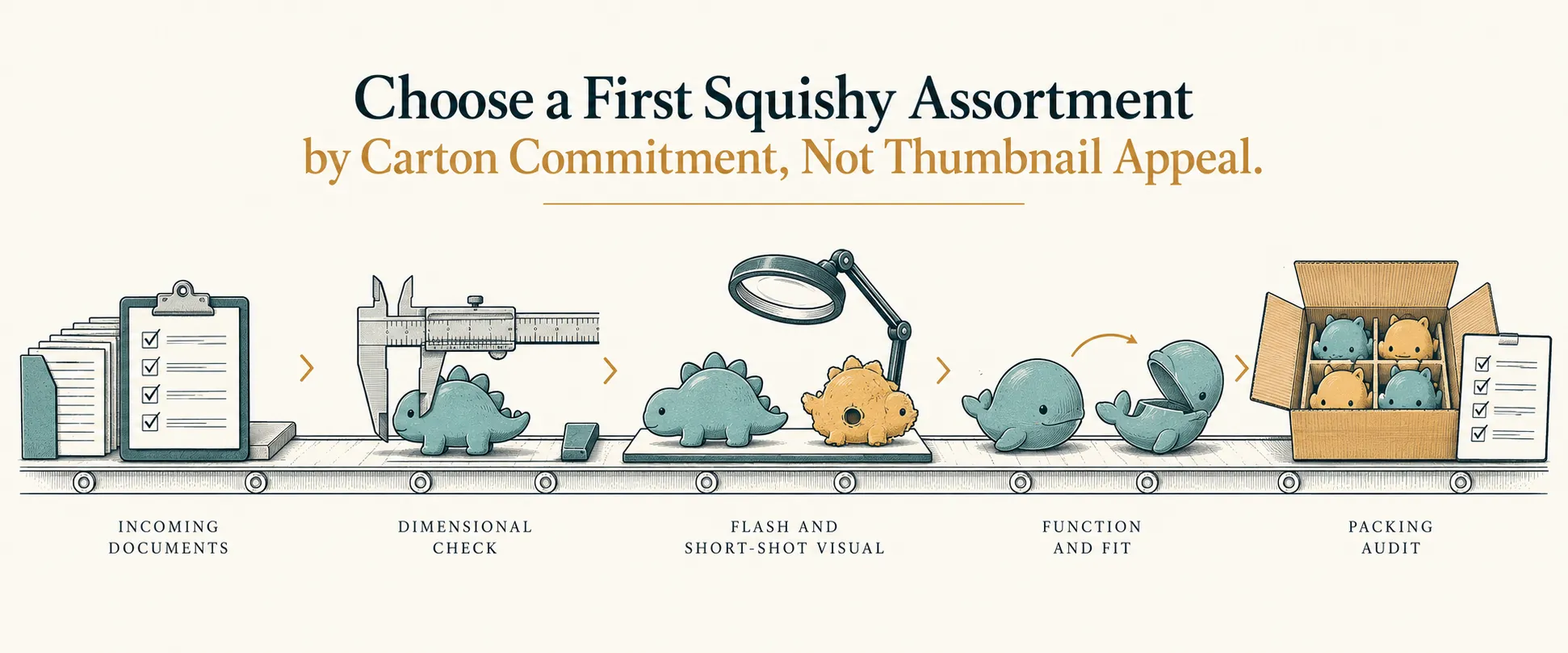
Squishy toy assortment planning starts with the carton, not the photo. A cute slow-rising animal that photographs well can still be the wrong first buy if its recorded MOQ forces you into more cartons than your cash and shelf space can absorb. The practical decision is this: shortlist SKUs whose documented minimum order, pieces per carton and CBM per carton fit the number of cartons you are willing to commit to, then treat appearance as a tiebreaker among those that already pass the arithmetic.
The method below keeps two things separate. One is commercial planning from recorded catalog fields — MOQ, carton quantity, carton dimensions, weights. The other is physical inspection of the closed shipping carton after production. Neither one certifies safety, and neither one replaces the specified laboratory test for a safety conclusion.
What do the recorded catalog fields actually tell you?
| SKU and name | Glitter Bead Baozi Squishy - 5.5 cm Glow Design (STS350810) |
|---|---|
| Recorded MOQ | 5 cartons / 1,440 pcs |
| Carton quantity | 288 pcs per carton |
| Carton size (cm) | 56 x 41 x 30 |
| CBM per carton | 0.069 |
| Net / gross weight per carton | 20.0 kg net / 22.0 kg gross |
| Recorded unit price basis | US$0.35 per pc, EXW, tiered by quantity |
| SKU and name | 113-Piece Marble Run Track Set (STS198230) |
| Recorded MOQ | 72 pcs |
| Carton quantity | 24 pcs per carton |
| Carton size (cm) | 67 x 33 x 70 |
| CBM per carton | 0.157 |
| Net / gross weight per carton | 13.5 kg net / 15 kg gross |
| Recorded unit price basis | US$2.5 per pc, EXW, tiered by quantity |
How do you turn MOQ into a carton count?
Divide the recorded MOQ by the carton quantity, then round up to whole cartons, because the factory ships full cartons. For the Baozi squishy, 1,440 divided by 288 gives exactly 5 cartons — the recorded MOQ is already expressed in cartons, so there is no remainder. For the marble run, 72 divided by 24 gives exactly 3 cartons. Both land on whole cartons, which is the clean case.
When the division does not land whole, the buyer pays for the surplus units needed to complete the last carton unless the supplier has agreed otherwise. A carton quantity is not automatically an order multiple, and a minimum MOQ is not a multiple either — check whether the supplier states a full-carton order restriction before you assume you must round up every line.
A recorded site rule states that eligible products and packaging projects carry a 120–600 piece per SKU band, and that the actual catalog MOQ and carton pack govern each SKU. Consolidation does not reduce an individual MOQ, and mixed retail sets or repacking need separate approval. Use the catalog figure, not the band, when you build the order.
Worked CBM example: what volume does your first assortment occupy?
CBM per carton is the number that decides freight and warehouse space, so calculate it rather than eyeballing the box. The formula is length (cm) × width (cm) × height (cm) ÷ 1,000,000, then multiply by the carton count. Using the recorded carton dimensions as an illustrative check: 56 × 41 × 30 = 68,880 cm³, ÷ 1,000,000 = 0.06888 CBM, which matches the recorded 0.069 CBM per carton. Five cartons give roughly 0.345 CBM.
Run the same check on the marble run: 67 × 33 × 70 = 154,770 cm³, ÷ 1,000,000 = 0.15477 CBM, consistent with the recorded 0.157 CBM. Three cartons give roughly 0.47 CBM. These are illustrative calculations from catalog dimensions, not a freight quotation, and they do not include pallet overhang or dunnage.
A recorded illustrative minimum-order scenario combines one carton of a 264-piece pack with five cartons of a 120-piece pack for 864 pieces in 6 cartons. Treat it as an arithmetic example only: it does not authorize mixed retail sets and it does not lower either minimum.
Which record do you compare at carton inspection?
Before the PO, capture the supplier's proposed packing data: carton dimensions and the unit of measure, pieces per carton, net and gross weight, and the shipping marks. After production, the final packed measurements and the packing list are the records you compare against. The packing list is the reconciliation document; the pre-PO sheet is the expectation.
Inspect the closed shipping carton in a fixed sequence. Measure length, width and height in the same unit the supplier used, and note the unit on the record. Count the pieces or inner packs and confirm the count against the packing list. Weigh the carton and compare net and gross against the recorded figures. Check carton strength and condition — compression, corner crush, water marks, tape integrity. Read the shipping marks for SKU, quantity, carton number and any handling symbols, and confirm they match the packing list.
Each check has a record, a discrepancy and a next decision. A dimensional difference within a buyer-agreed tolerance is a note, not a failed shipment; a count shortfall is a claim; a crushed or wet carton triggers a hold and a re-inspection before the goods go to storage. Set the tolerance in writing before production so the inspection has a pass/fail line rather than a judgment call on the dock.
Where does product-safety testing fit?
Product-safety testing is a separate release check, not an appendix to carton review. A carton that measures correctly and counts correctly tells you nothing about whether the toy meets the applicable safety requirements; a buyer's hand check does not certify safety or determine an age grade. For a safety conclusion, use the specified laboratory test.
Official US recall records show why the distinction matters. A 2026 recall of a rainbow rattle and teething toy cited a glued knot on an elastic cord that could come untied, exposing small wooden and plastic pieces CPSC 26-719. A separate 2026 recall of doll and stroller toys cited a small pacifier that violated the small parts ban for children under three, plus detachable plush-bear eyes CPSC 26-561. A 2026 recall of magnetic board games cited loose high-powered magnets in the game pieces CPSC 26-265. These are historical external cases involving the named products only; no connection to this supplier, its customers or its SKUs is established. The transferable point for a buyer is that construction features — knots, detachable parts, accessible magnets or button cells — are what a laboratory test evaluates, and a carton inspection does not.
Keep destination-specific paperwork separate from the carton review. Import documentation, labeling rules and any market-specific declaration are their own checklist; do not fold them into the packing-list reconciliation, and do not assume one market's rule applies to another.
Buyer questions on first-assortment carton planning
Can I mix SKUs to reach a lower total order?
Consolidation does not reduce an individual SKU's MOQ. Each line still has to meet its own recorded minimum, and mixed retail sets or repacking need separate approval.
Is the carton quantity the same as the order multiple?
No. A carton quantity tells you how many pieces ship per carton; it is not automatically an order multiple. Confirm whether the supplier states a full-carton order restriction before you assume you must round up every line.
What tolerance should I set for carton dimensions?
Set it yourself and put it in writing before production. A buyer-agreed tolerance turns a dimensional difference into a note rather than a failed shipment. It is a commercial screening criterion, not a compliance standard.
Does a clean carton inspection mean the toy is safe to sell?
No. Carton inspection verifies packing, count, weight and marks. Safety is a separate release check, and a safety conclusion requires the specified laboratory test rather than a hand check.
How do I compare two SKUs when one has a much higher MOQ?
Convert each MOQ into cartons and CBM first. If the higher-MOQ SKU still fits the cartons you are willing to commit to, it can be the better first buy; if it does not, appearance should not override the arithmetic.
Next step
Send your shortlist of candidate SKUs with the carton count and CBM you can commit to, and ask for the proposed packing data — carton dimensions and unit, pieces per carton, net and gross weight, and shipping marks — so you can compare it against the final packed measurements and packing list before the order is placed.