From the sourcing desk
Carton Volume per Unit: Accept or Recheck Two Catalog Packs
Repeat two catalog carton-volume calculations, reconcile rounded CBM, and check dimensions, count, weight, strength, and marks before shipment approval.
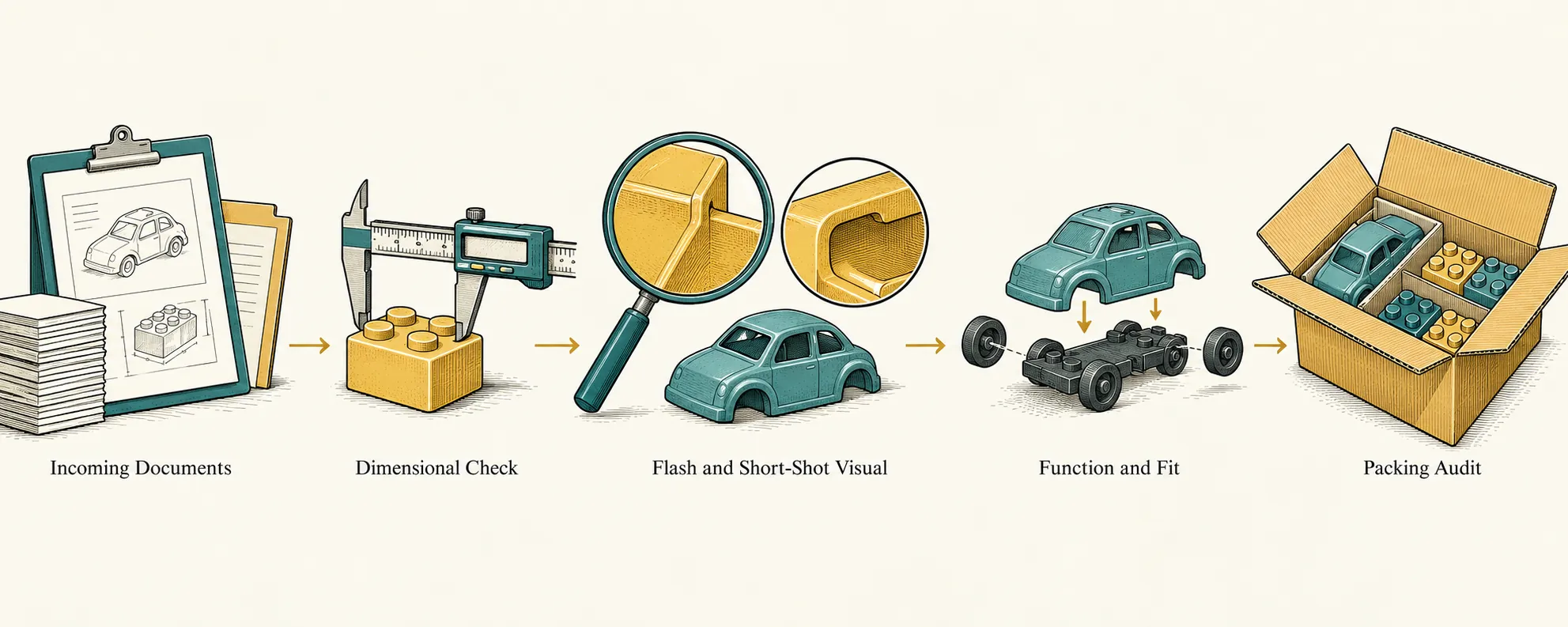
Accept carton volume per unit as a preliminary planning figure—not a freight charge—only after matching the carton CBM and unit count to the exact pack configuration. The two catalog examples yield approximately 0.00015909 m³ per squishy and 0.00040833 m³ per maze cube using recorded CBM. Both carton volumes reconcile with their listed dimensions after rounding, so the arithmetic supports initial planning; final approval still requires checking the closed shipping carton against the agreed packing specification and packing list.
How do product dimensions, carton CBM, and chargeable freight volume differ?
Product dimensions describe the item, carton CBM describes the outside shipping-carton envelope, and chargeable freight volume or weight follows the selected transport service’s billing rules.
Keep the retail package separate, too. The ice-cube squishy’s catalog package size is 5 × 5 × 5 cm; the maze cube’s is 7.2 × 7.2 × 7.2 cm. Neither is the master-carton measurement. Multiplying a product’s dimensions by its quantity does not reproduce the shipping carton’s outside volume.
For this check, use outside carton length × width × height, then divide by units in that carton. Interior measurements help assess packing fit but cannot replace outside dimensions in shipment CBM. The Carton Packing Planner makes that distinction explicitly.
Do not enter the resulting m³-per-unit figure into a freight budget as though it were a price or chargeable weight. Record final external dimensions and gross weight, then obtain the applicable carrier or forwarder calculation for the chosen service. DHL weight and dimensions guidance addresses dimensional-weight calculations for its services, not a universal rule for every shipment.
What does the completed two-product carton-volume check show?
| Maltose Ice-Cube Squishy — 3.5 cm | SKU: STS348379. Source: October 15, 2026 catalog snapshot. Pack configuration: OPP; 264 units/carton. Recorded carton size, to verify as closed outside dimensions: 44 × 21.5 × 44 cm. Recorded carton CBM: 0.042 m³. Dimension check: 44 × 21.5 × 44 ÷ 1,000,000 = 0.041624 m³, which rounds to 0.042 m³. Illustrative catalog-based volume per unit: 0.042 ÷ 264 ≈ 0.00015909 m³/unit. Using the dimension product instead: 0.041624 ÷ 264 ≈ 0.00015767 m³/unit. Status: ACCEPT for preliminary planning using the stated catalog-CBM basis; PHYSICALLY VERIFY before final shipment approval. |
|---|---|
| Handheld 3D Ball-Maze Cube | SKU: STS342803. Source: October 15, 2026 catalog snapshot. Pack configuration: color box; 120 units/carton. Recorded carton size, to verify as closed outside dimensions: 44.5 × 30 × 37 cm. Recorded carton CBM: 0.049 m³. Dimension check: 44.5 × 30 × 37 ÷ 1,000,000 = 0.049395 m³, which rounds to 0.049 m³. Illustrative catalog-based volume per unit: 0.049 ÷ 120 ≈ 0.00040833 m³/unit. Using the dimension product instead: 0.049395 ÷ 120 = 0.000411625 m³/unit. Status: ACCEPT for preliminary planning using the stated catalog-CBM basis; PHYSICALLY VERIFY before final shipment approval. |
Which CBM figure should the buyer retain?
Retain the catalog CBM when reproducing the supplier’s planning figure, but use final measured outside dimensions for the shipment’s physical volume record.
Here, one rounded catalog value is above the dimension-derived result and the other is below it. That is a rounding difference, not evidence by itself of a packing error. Preserve the unrounded multiplication in the worksheet and state whether the per-unit result uses recorded CBM or calculated CBM. Otherwise, two reviewers can repeat valid arithmetic and still produce different answers.
Do not transfer either figure to a revised pack without checking it again. A different retail box, insert, carton count, or outer carton can change the result. Accept the planning basis when the configuration matches and the difference is explained by the agreed rounding convention; request correction when the figures remain inconsistent after units, dimensions, count, and rounding have been checked.
How do you calculate total shipment CBM?
Calculate shipment CBM from each closed carton’s outside dimensions and the number of cartons using that configuration, rather than from product dimensions.
Explicitly hypothetical example—all inputs below are illustrative: assume 10 identical closed cartons, each measuring 50 × 40 × 30 cm. One carton is 50 × 40 × 30 ÷ 1,000,000 = 0.060 m³. Total shipment carton volume is 0.060 × 10 = 0.600 m³.
For different carton sizes, calculate each size separately and add the results. A part-filled carton still occupies its measured outside envelope. Consequently, a full-carton m³-per-unit estimate can understate volume per shipped unit when the shipment includes part-filled cartons. Reconcile actual carton counts and actual unit counts before approving the final total.
That total describes carton volume. It is not a freight quotation or proof of physical loading capacity; the Carton Packing Planner likewise excludes a freight rate and a guaranteed loading plan from its output.
What should be inspected on the closed shipping carton?
| Outside dimensions and CBM | Compare: measured closed-carton L × W × H and calculated CBM against the approved packing revision. Discrepancy signal: a difference beyond buyer-agreed tolerance, inconsistent units, or a carton that closes only with visible distortion. Next decision: remeasure and confirm configuration; accept an explained difference within tolerance, or correct the packing record and shipment-volume calculation. |
|---|---|
| Units per carton and total count | Compare: the packing tally and agreed count verification with carton labels and the packing list. Identify part-filled cartons separately. Discrepancy signal: the counted contents, printed carton quantity, and packing-list quantity do not reconcile. Next decision: recount affected cartons, correct packing or labels as appropriate, and recalculate totals before approval. |
| Gross and net weights | Compare: measured gross weight with the agreed target and final packing list; reconcile net weight against the documented contents-weight basis. Catalog reference targets are 17.8 kg gross/15.8 kg net for the squishy carton and 15.0 kg gross/13.0 kg net for the maze-cube carton. Discrepancy signal: an unexplained difference beyond the agreed tolerance or inconsistent gross/net definitions. Next decision: verify the scale, count, and packing-material basis, then correct the record or packing. |
| Carton construction, strength, and closure | Compare: the packed carton with the agreed board specification, approved packing sample, and closure method. Discrepancy signal: a construction substitution, crushed corners, bowed panels, split seams, or damaged closure. Next decision: re-pack or replace affected cartons and resolve any required transport or stacking validation. A visual inspection alone does not establish carton strength. |
| Shipping marks and carton identity | Compare: carton marks with approved artwork, order references, carton numbering, item identity, stated quantity, and the final packing list. Check barcode readability when the receiving workflow uses a barcode. Discrepancy signal: unreadable or conflicting identification, duplicate numbering, or a quantity label that does not match contents. Next decision: correct the marks and reconcile the affected packing-list entries before release. |
When should the status be accept, correct, or physically verify?
Use ACCEPT for a reconciled figure within agreed conditions, CORRECT for a data or packing discrepancy requiring correction and recheck, and PHYSICALLY VERIFY when the packed configuration still needs confirmation. Record the scope of acceptance: accepting a catalog-based planning figure is not final shipment approval.
Keep the calculation inputs together in this two-row check record. The dimensions, carton CBM, and counts below are supplier-recorded catalog data, not measured shipment results. The per-unit results are illustrative planning figures calculated from recorded carton CBM; confirm the listed dimensions as the closed carton's outside measurements before final approval.
| SKU | Recorded carton outside dimensions, L × W × H (cm; to verify) | Recorded carton CBM (m³/carton) | Units/carton | Illustrative carton CBM per unit (m³/unit) | Source revision or date | Status | |---|---|---|---|---|---|---| | STS348379 | 44 × 21.5 × 44 | 0.042 | 264 | 0.042 ÷ 264 ≈ 0.00015909 | October 15, 2026 catalog snapshot; OPP pack | ACCEPT for preliminary planning on the recorded-CBM basis; PHYSICALLY VERIFY before final shipment approval | | STS342803 | 44.5 × 30 × 37 | 0.049 | 120 | 0.049 ÷ 120 ≈ 0.00040833 | October 15, 2026 catalog snapshot; color-box pack | ACCEPT for preliminary planning on the recorded-CBM basis; PHYSICALLY VERIFY before final shipment approval |
For the two catalog examples, the arithmetic passes a rounding check; the final packed measurements remain a separate approval step. A matching CBM does not demonstrate that dividers are correct, closures hold, or cartons withstand stacking. The Carton Packing Planner specifically notes that its rectangular model does not validate compression, dividers, stack strength, or pallet stability and calls for checking actual filled packs and final gross weight. Obtain the selected carrier's current chargeable-volume or chargeable-weight rule separately; this record is neither a carrier document nor a loading plan.
On the shipment copy of the check record, add the order reference, packing-specification revision, inspection date, carton identifiers, specified targets, observed measurements, and decision conditions. Keep targets and observations in separate fields. Record the responsible approver and approval date. For each correction, name an owner, record the follow-up action, and close it with the recheck result and closure date. This creates traceability; it does not by itself detect an undisclosed packing change.
Keep product-safety testing as a separate release check. Carton arithmetic and a buyer's packing inspection do not certify the product.
What service next step supports shipment approval?
Request a carton-data reconciliation for these two pack configurations, with coordination of a physical packing check where needed, so the final dimensions, counts, weights, and shipping marks can be reviewed against the approved packing revision and packing list.