From the sourcing desk
Toy Packaging Quote Revisions: What to Approve
Copy a quote revision sheet for mid-order toy packaging changes. Compare quantities, charges, artwork, labor and cartons before releasing the change.
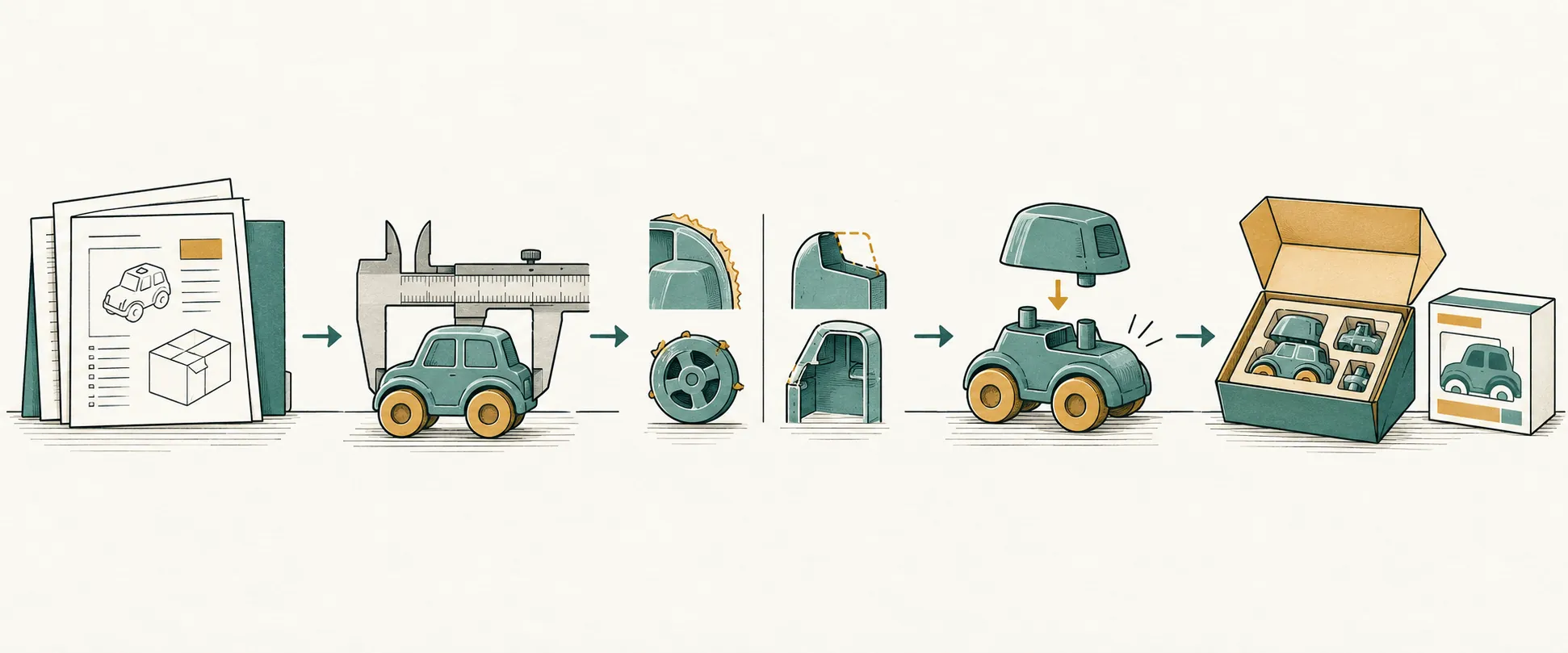
Approve a mid-order toy packaging change only against a versioned quote revision sheet that identifies the affected units, revised packing instructions and explicitly accepted incremental charges. Keep the original approved version active until the replacement is released, and place affected work on hold where continuing would conflict with the proposed change. The sheet below gives a toy brand or distributor one record for comparing the old and proposed scope, recording sample observations, and authorizing—or rejecting—the change.
A revised artwork file is not a revised purchase instruction. Quoted, sampled and produced versions can diverge when changes move through separate messages without a controlled revision. Use the sheet as a release control, not merely an email attachment. It supports traceability; it cannot by itself detect an undisclosed substitution. SourcingAll
What belongs on the toy packaging quote revision sheet?
| Order and revision identity | Enter buyer and supplier names, purchase order number, product/model reference, original quote number and revision, proposed quote revision, change-sheet revision, issue date and requester. Identify the exact approved record being replaced. |
|---|---|
| Change reason and boundary | Describe the requested change and why it is needed. State what remains unchanged, including the toy, assortment, accessories and any packaging elements outside the request. |
| Production status and affected quantity | Record total ordered pieces, pieces already packed, pieces awaiting packing and pieces requiring rework. Identify affected lots or order lines and the cut-in point for the new packaging. |
| Ordered quantity and selling-unit definition | Compare ordered pieces and sellable packs. Define whether one quoted unit means one toy, one multipack, one display or one carton; show pieces per sellable pack. Record any quantity change separately from a packaging price change. |
| Unit price and commercial basis | Record currency, price per defined unit, quantity tier, trade term and named place, plus included and excluded services. Keep the old and proposed prices on the same basis for comparison. |
| Packaging specification | Identify the old and proposed format, dimensions, material specification and packing instruction revision. Record components added, removed or retained. |
| Carton pack-out | Compare pieces per inner pack, inner packs per master carton, pieces per master carton, full-carton count and loose balance. Record any agreed partial-carton treatment without assuming carton quantity is an order multiple. |
| Carton dimensions, volume and weight | Enter specified outer-carton dimensions and measured results, CBM per carton, shipment CBM, and gross and net carton weights. Identify whether each value is a target, calculation or measurement. |
| Artwork and label files | List exact filenames, revisions, dates, dieline references, languages and placement instructions. Identify the proof or physical sample linked to each proposed file, including applicable barcode and carton-marking files. |
| Labor scope | Specify printing, folding, assembly, labeling, unpacking, repacking and carton replacement separately. State which operations are included in the revised unit price and which are quoted separately. |
| Existing packaging and work in progress | Record packaging already purchased, printed or used. Specify the proposed reuse, rework, storage or disposal decision, affected quantity and any separately quoted charge or credit. |
| Logistics | Compare shipping mode, destination, receiving instructions, consolidation, palletization and carton markings. Record the supplier-confirmed schedule impact and any freight quote reference; do not carry the original freight amount forward without review. |
| Incremental charges and credits | For each line, record description, charging unit, affected quantity, rate, extended amount, currency, charge or credit, and buyer approval status. Show the net change and revised order total. |
| Proof or sample acceptance | State the specified target, required proof or sample reference, observed result, reviewer and review date. Record pass, hold or reject with any conditions. Distinguish a proposed specification from an accepted observation. |
| Decision and authority | Select approve, conditional approval, reject or hold. Record the exact sheet and quote revisions, accepted incremental amount and currency, release conditions, authorized buyer name, role and approval date. Record the supplier's acknowledgment and date. |
| Follow-up closure | Assign an owner and due date to each open condition. Record closure evidence, verifier and closure date, followed by the named person and date authorizing release of the affected work. |
How should incremental charges be approved before work proceeds?
Require the supplier to itemize the net price change and obtain dated buyer approval for that specific revision before starting the affected packaging work or incurring change-specific charges.
Separate recurring packaging cost from one-time setup, rework, unused-material disposition and logistics adjustments. If label application is already included in the revised per-piece price, do not accept the same operation again as a separate labor line without an explanation.
For an unchanged affected quantity Q, calculate the recurring change as Q × (revised price per defined unit − approved price per defined unit). Add separately quoted one-time charges and logistics adjustments, then subtract agreed credits. If quantity or the selling-unit definition changes, first reconcile those differences; a price per toy cannot be compared directly with a price per multipack.
Use explicit approval wording: “Approve change-sheet revision [reference] and revised quote [reference], including a net incremental charge of [amount and currency], for [affected quantity and scope]. Release is subject to [conditions]. No additional change-specific charges are authorized without further written approval.”
A no-price-impact revision still needs a decision: record “No incremental charge—reviewed and accepted,” with the supplier confirmation, buyer name and date. A blank price cell is not the same as an agreed zero change. SourcingAll
How does a packaging change alter carton count without changing order quantity?
| Revision status | Illustrative baseline: original approved OPP configuration. Proposed revision: OPP plus printed sleeve; pending fit review and commercial approval. |
|---|---|
| Ordered quantity | Illustrative comparison: 528 pieces before and after; change = 0 pieces. The quantity exceeds the catalog minimum of 264 pieces. |
| Unit basis | Catalog basis: EXW, per piece. Illustrative proposed comparison: retain that basis and quote the sleeve-related change separately or within a clearly identified revised per-piece price. |
| Pieces per carton | Catalog baseline: 264. Illustrative proposed target: 176. The proposed count is a packing assumption, not an observed sample result. |
| Carton count | Illustrative baseline: 528 ÷ 264 = 2 cartons. Illustrative proposal: 528 ÷ 176 = 3 cartons. Increase: 1 carton; no loose balance in either calculation. |
| Carton volume calculation | Catalog dimensions: 0.44 × 0.215 × 0.44 m = 0.041624 m³ per carton. Illustrative proposal assumes these dimensions remain unchanged. |
| Shipment volume | Illustrative baseline: 2 × 0.041624 = 0.083248 m³. Illustrative proposal: 3 × 0.041624 = 0.124872 m³. Calculated increase: 0.041624 m³, or 50%. |
| Artwork and labor scope | Illustrative proposed scope: a revision-controlled sleeve file plus sleeve application. The supplier must identify whether the rate includes application, extra cartons and any repacking of completed units. |
| Decision and release condition | Illustrative decision: HOLD affected packing. Release only after sleeve fit and measured pack-out are accepted, updated logistics are reviewed, and itemized incremental charges are explicitly approved. |
What must be checked before approving the worked change?
For the illustrative sleeve change, approve the price only after the supplier confirms the packing configuration that the price and logistics calculation actually cover.
Request a representative packed sample and carton pack-out record. Compare sleeve fit, closure, file revision, packed count, measured outer dimensions and weight against the proposed targets. A screenshot can support artwork review; it does not establish physical fit or carton capacity. Changes to dimensions, materials or closures may warrant representative sample review rather than relying on the previous approval. J-Origin Packaging
The calculated 50% volume increase is not a forecast of a 50% freight-price increase. Request an updated logistics calculation using the confirmed dimensions, weights, mode and destination. Recalculate CBM whenever carton dimensions or pack-out change, and keep rounding consistent.
The example also does not establish a full-carton ordering restriction. Carton quantity describes the pack-out; it does not automatically require purchasing surplus toys. Record any proposed partial carton or changed order quantity as a separate commercial decision.
What happens after approval, conditional approval or rejection?
Approval releases only the identified revision and scope; conditional approval leaves the stated work on hold until the conditions are closed.
After final approval, reissue the complete release pack: revised quote, change sheet, packing instructions, artwork, relevant sample acceptance and logistics details. Mark superseded documents “do not use” or “superseded,” while retaining them in the order history. Obtain supplier acknowledgment of the current revision, affected quantity and cut-in point. Reissuing the full pack and confirming supplier understanding are recommended revision-control practices. SourcingAll
If the change is rejected, the last approved version remains the authorized specification. Separately confirm whether affected work can resume under that version; do not assume rejection resolves the disposition of packaging already made or work already completed. Close those items with an owner, decision and date.
For the next step, send your completed revision sheet, current quote and proposed packaging files to your packaging coordinator for an itemized change quote and proof or sample review before release.