From the sourcing desk
Catalog vs Test Report: Auditing Toy Spec Fields
An evidence audit of toy catalog specification fields: how to separate supplier-listed documents, readable specs and verified report evidence before you buy.
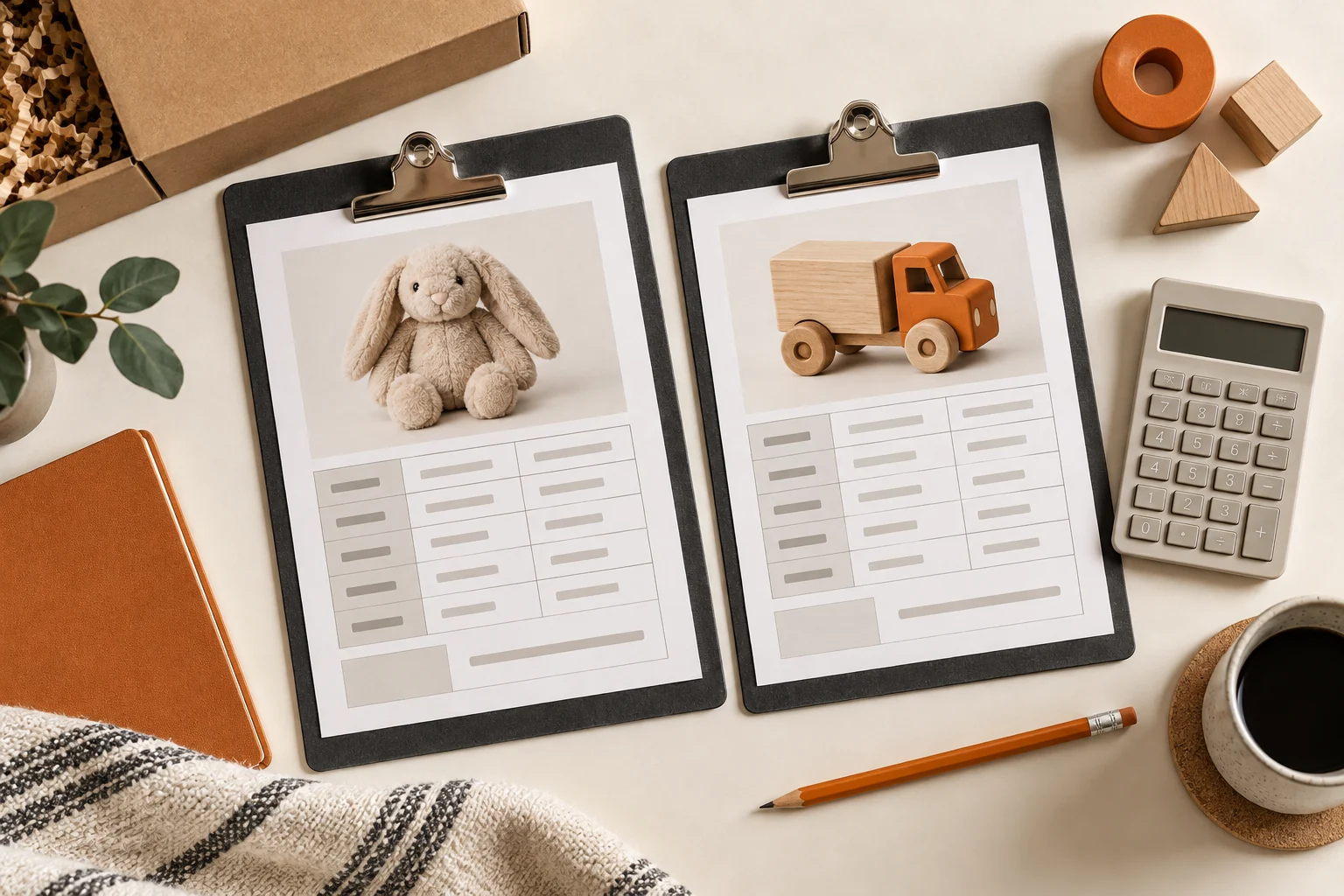
A catalog entry is a supplier's description of a product; a test report is evidence about a specific sample. Treating one as the other is the single most expensive shortcut in toy sourcing. The practical rule: count only fields you can actually read, label missing or garbled text as unknown, and never let a listed document stand in for a verified report.
This audit walks through a 164-record catalog snapshot to show where specification fields hold real information and where they are placeholders. The outcome for buyers: a repeatable way to decide which fields you can rely on for a purchase decision and which you must verify against an original report before committing an order.
What does the 164-record catalog snapshot actually contain?
The snapshot is a set of 164 product records pulled from a supplier catalog. It is a source-selection sample, not a survey of the market and not this site's sales. Each record was read for three things: supplier-listed documents, readable specification fields, and any verified report evidence. The observation period is the snapshot as captured; no time series is implied.
The point of counting is to keep the denominator honest. If a field is blank, truncated, or garbled, it is unknown — not zero, not 'probably fine'. A record with a readable material field and a blank age-grade field has one usable field, not two. That distinction is what separates an audit from a wish list.
Supplier-listed documents, readable specifications, verified report evidence: three different things
A supplier-listed document is a claim in the catalog — a line that says a certificate or report exists. A readable specification is a field you can parse: material, dimensions, age grade, packaging. Verified report evidence is a report whose identity matches the actual SKU, model, material, color, age grade and sample construction.
These three are not interchangeable. A catalog that lists 'ASTM tested' tells you the supplier asserts testing happened. It does not tell you which sample, which laboratory, which version of the standard, or which colors were covered. For a growing Amazon or Shopify brand, that gap is where recalls and listing takedowns live.
How to classify each catalog field
| Supplier-listed document | A catalog line claiming a certificate or report exists. Supports: a follow-up request for the original. Does not support: a compliance conclusion. |
|---|---|
| Readable specification | A parseable field such as material, dimensions, age grade or packaging. Supports: product comparison and sampling briefs. Does not support: safety or performance claims. |
| Verified report evidence | A report whose product, model, material, color, age grade and sample construction match the SKU. Supports: the compliance file. Requires the original document, not a catalog summary. |
| Missing field | Blank or absent. Label unknown. Do not infer a value from a similar SKU. |
| Garbled field | Truncated, mistranslated or unreadable text. Label unknown. Request a corrected data sheet. |
Which US requirements apply to toys for children 12 and under?
For toys for children 12 and under sold in the US, the importer must have third-party testing at a CPSC-accepted laboratory and a Children's Product Certificate. The importer issues that certificate for toys made outside the United States and stays legally responsible for it, even when the factory arranges the tests Allied CHB.
The mandatory toy standard cited in the source is ASTM F963-23, in force for toys made from April 20, 2024, and the CPC must cite that version. Chemical and small-parts limits cited include lead in accessible substrate at 100 ppm, lead in paint and surface coatings at 90 ppm, eight phthalates each limited to 0.1 percent, and small-parts testing for items for children under three Importivity.
Two operational points follow. Since July 8, 2026, the importer must file certificate data for CPSC-regulated products in ACE when the entry is filed, and the importer must show the certificate within 24 hours of a CPSC or CBP request Allied CHB. A catalog line saying 'CPC available' does not satisfy any of this. The original certificate, citing the correct standard version, does.
Why does report identity matter more than the report's existence?
A report protects nobody if it names a similar item or a different plant. The check is whether the machine, certificate and test report addresses match, whether the report names the exact product and factory address, whether it covers every color and material, and whether it is dated within a year for the same tooling Importivity.
In catalog terms, this is the difference between a listed document and verified evidence. A catalog field that says 'test report: yes' is a supplier-listed document. The report itself, with matching identity, is verified evidence. Only the second one belongs in your compliance file.
Worked example: reading one catalog record
| Catalog field: material | Readable — 'plush, polyester fiber fill'. Usable for a sampling brief. |
|---|---|
| Catalog field: age grade | Garbled — '3+ / 0-3' contradictory. Label unknown. Request correction. |
| Catalog field: certificate | Supplier-listed — 'CPC available on request'. Follow up for the original. |
| Catalog field: test report | Missing. Label unknown. Do not assume testing occurred. |
| Catalog field: packaging | Readable — 'OPP bag'. Usable for carton planning. |
| Usable fields in this record | 2 of 5 (illustrative count) |
How should a brand use this audit before placing an order?
Build a one-page evidence sheet per SKU. List every field, mark it readable, supplier-listed, verified or unknown, and attach the original documents you actually hold. Anything still marked unknown goes on the follow-up list before the purchase order, not after.
For a growing Amazon or Shopify brand, the practical sequence is: sample first, confirm the sample construction matches the specification, then request the original report and certificate and check that the identity fields match the SKU you are buying. If the report names a different model or a different factory address, treat it as a supplier-listed document, not verified evidence.
One more caution on capacity claims: a factory's stated capacity is a planning input, not a verified fact, until the product type, machine mix, shifts, tooling and recent records are checked. The same logic applies to catalog fields — a number in a column is a claim until you can trace it.
Frequently asked questions
Does a catalog listing a CPC mean the product is compliant?
No. The listing is a supplier-listed document. Compliance depends on the original certificate, issued by the importer, citing the correct standard version and matching the actual product.
What should I do with a garbled specification field?
Label it unknown and request a corrected data sheet. Do not infer the value from a similar SKU or from the product name.
How current must a test report be?
The source advises reports dated within a year for the same tooling, naming the exact product and factory address and covering every color and material. Treat that as a buyer check, not a universal rule.
Can I rely on tests the factory arranged?
You can rely on factory-arranged tests, but the importer stays legally responsible for the certificate. Verify the report identity before you file it.
What changed for US toy imports in 2026?
Since July 8, 2026, the importer must file certificate data for CPSC-regulated products in ACE when the entry is filed. Separately, toys in HTS 9503.00.00 pay a 12.5 percent Section 301 forced labor duty since July 24, 2026. Confirm the full 10-digit HTS number and origin for your shipment.
Sources
- Toy Manufacturers in China and How to Vet One | Importivity
- Importing Toys: CPSC Certificates, eFiling, Testing and Duties | Allied CHB
Next step
If you are auditing a catalog before an order, start by requesting the original test report and certificate for one SKU and check the identity fields against the product you intend to buy. That single check tells you whether the rest of the catalog is worth trusting.