From the sourcing desk
Toy Sample Version Control: Sign-Off Sheet Fields
Build a versioned toy sample approval sign-off sheet: fields for SKU, artwork revision, dimensions, packaging, date and disposition, plus the bulk comparison step.
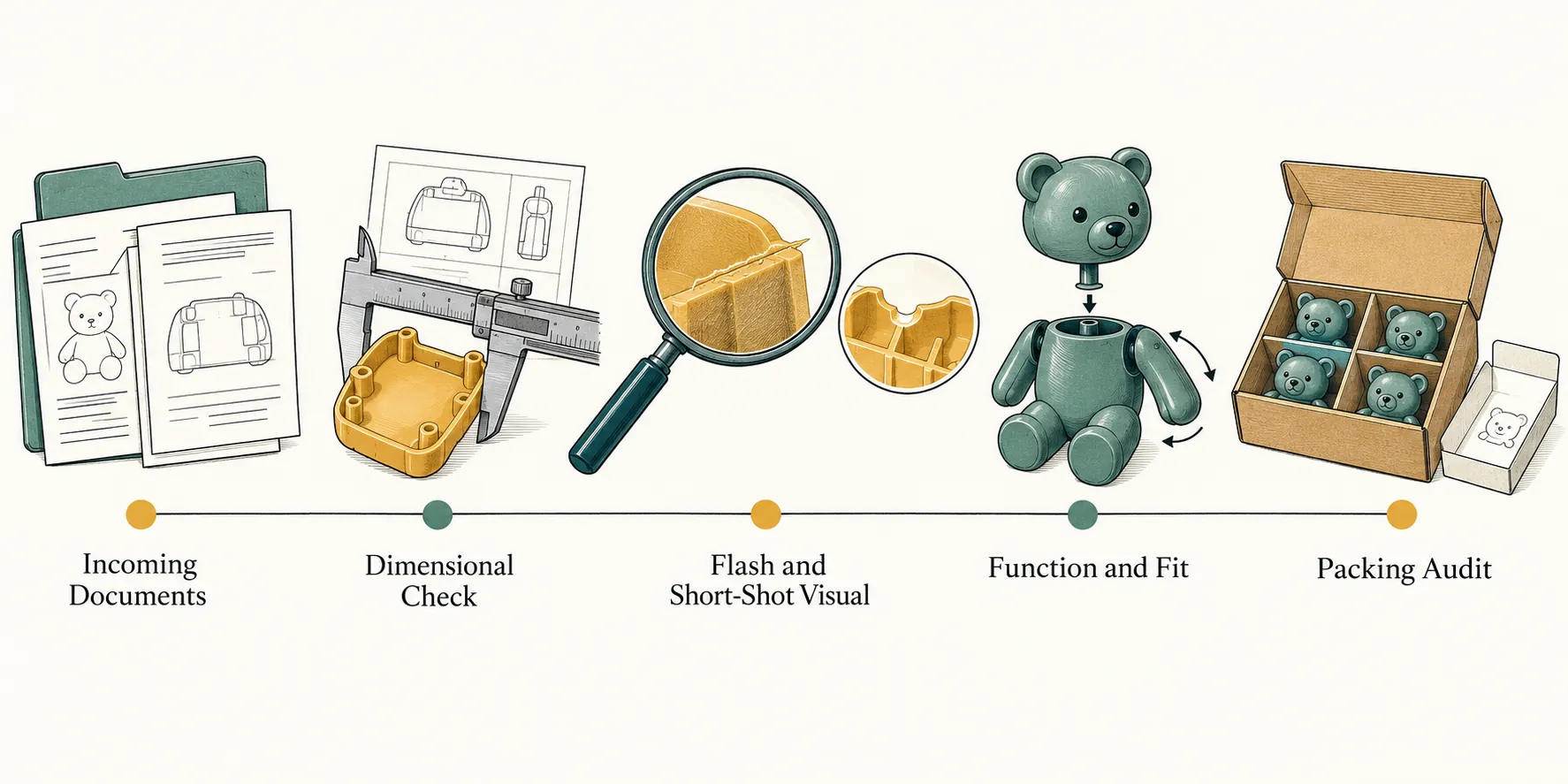
Toy sample version control means every approved sample carries a version number, a date and a written disposition, so the physical piece on your shelf can be traced back to the exact specification it was approved against. A sign-off sheet without a revision number is just a photo with a date on it — the next artwork tweak or colour change erases its authority.
The practical decision: approve the first sample only after comparing it against the agreed written specification and design requirements, then create and retain the approved production reference. Everything after that — bulk inspection, reorders, a second factory quote — is measured against that reference, not against memory.
What fields belong on a toy sample approval sign-off sheet?
A working sheet has three layers: identity, evidence, and disposition. Identity tells you what was approved and which revision it belongs to. Evidence records what you actually observed. Disposition is the decision — approved, approved with conditions, or rejected — plus who signed and when.
Keep identity fields unambiguous. A SKU alone is not enough if the same SKU runs in two colourways or two packaging formats; add a supplier code and a sample type (first article, revised artwork, re-submission after correction). The version number is the field that makes the rest of the document enforceable.
Evidence fields should mirror the specification line by line rather than describing the sample in prose. If the spec says 180 mm body length with a 5 mm tolerance, the sheet carries a measured value, not the word "correct". Photos are supporting evidence, not the record itself — a missing photograph does not invalidate a review that has measured values and a signed disposition, but it does weaken a later dispute.
| SKU / item code | Your internal code; one row per sellable variant |
|---|---|
| Supplier code / model | The factory's own reference for the same item |
| Sample type | First article, revised artwork, re-submission after correction |
| Version number | Sequential, e.g. V1, V2 — never reuse a retired number |
| Sample photographs | Front, back, base, packaging, any printed panel |
| Measured dimensions | Value plus tolerance from the written specification |
| Material and finish | As specified, with any substitution noted |
| Packaging format | Poly bag, header card, colour box, sleeve, insert |
| Artwork revision | The designer's file revision, matched to the printed piece |
| Date received / date reviewed | Two dates, not one |
| Disposition | Approved, approved with conditions, or rejected |
| Signatory and role | Named person, not a department |
How do you check a sample against the written specification?
Work through the specification in the order it was written, and record a value for every line — even the ones that pass. The checks below cover the categories that matter for a soft or moulded toy, but the sequence is the same for any category: function first, then materials, then finish, then dimensions, then packaging.
Function. Operate the toy the way the end user will. Squeeze it, stretch it, open and close any moving part, press any button. Note whether the action returns to shape, whether seams hold, and whether anything rattles or separates. This is a commercial check on build quality, not a safety test.
Materials. Confirm the material named in the specification is what you can see and feel, and ask for the material declaration where the spec calls for one. A substitution that looks harmless on a soft toy can change weight, smell and how the item photographs.
Finish and colour. Compare against the approved colour reference under daylight, not under the factory's overhead lighting. Look for flash, sink marks, uneven print registration and colour drift between components of the same item.
Dimensions. Measure the points the specification marks as critical, with a tool that matches the tolerance. Record the measured value, not a tick box.
Packaging. Check the format, the panel layout, the barcode placement and the printed revision code. Package dimensions and quantity per inner or carton should be based on measured production packaging, not only a preliminary artwork file — a sleeve drawn at 210 mm can print and fold to something else.
Worked example: a sleeve revision, with illustrative numbers
Suppose a squishy toy ships in a printed cardboard sleeve and the brand wants the back panel reworded. The first sample was approved as V1. The factory prints the new back panel and sends a revised sample. The sheet is opened as V2, with the artwork revision field carrying the designer's file number for the new panel.
The reviewer measures the sleeve at 212 mm against a specified 210 mm, notes that the print registration on the front logo sits 1 mm low, and confirms the barcode scans. The disposition is "approved with conditions": the 2 mm oversize is accepted because the sleeve still fits the measured carton, and the registration offset is logged for the next print run. Both notes go on the sheet, not in an email thread.
The numbers here are illustrative, not a specification. What matters is the pattern: a new version number, a measured value against a tolerance, a named condition, and a retained copy. If the same panel is revised again, the next sample becomes V3 and V2 is retired — a superseded version should not stay in circulation as a working reference.
| Version | V2 (V1 superseded) |
|---|---|
| Change requested | Back panel wording, front logo unchanged |
| Artwork revision | Designer file revision for the new back panel |
| Sleeve length, specified | 210 mm (illustrative) |
| Sleeve length, measured | 212 mm (illustrative) |
| Print registration | Front logo 1 mm low (illustrative) |
| Barcode | Scans correctly |
| Disposition | Approved with conditions |
| Conditions | Oversize accepted; registration offset logged for next run |
What happens after a discrepancy on a sample?
A discrepancy does not automatically mean rejection. Sort it into three buckets before you reply: cosmetic, dimensional, or functional. Cosmetic issues that a buyer would not notice at arm's length can be accepted with a note. Dimensional drift inside the stated tolerance is a pass. Anything that changes how the toy works, how it feels, or whether it fits its packaging is a correction request.
Write the correction as a numbered list against the specification line, with the measured value and the required value side by side. Vague feedback such as "colour looks off" produces a second sample that misses again. "Body colour is two shades darker than the approved reference; match the V1 reference under daylight" gives the factory something to hit.
When the corrected sample arrives, it gets a new version number and a fresh sheet. Do not amend the old sheet — the history of what was rejected and why is the part that protects you on the next order.
One caution on safety: a hand check on a sample tells you about build quality and consistency. It does not establish regulatory compliance, and it cannot determine an appropriate age grading. Where the specification calls for laboratory testing, that conclusion comes from the specified test, not from a pull or squeeze performed on your desk.
Bulk comparison is the next stage, not the same one
Sample approval answers one question: does this piece match the written specification? Bulk comparison answers a different one: does the production run match the approved reference, consistently, across the quantity you are paying for?
The comparison is only as good as the reference. A sealed approved sample, held with the approved material, colour, decoration, dimensions and photographs, gives an inspector something to hold next to a pulled unit. It complements the specification and the change records — it does not replace them, and it is not the only valid basis for a bulk inspection. If the specification and the retained sample ever disagree, the written specification governs and the sample gets re-approved.
For a soft toy, a practical bulk check looks at the same categories as the sample review — function, materials, finish, dimensions, packaging — applied to a defined number of pulled units rather than one. How many units you pull and what tolerance you accept are your own screening criteria; they are not a compliance standard and they do not predict a return rate.
One more thing worth writing into the reference: the freeze point. If a colour or artwork change is agreed after the reference is locked, record the change date, the changeover time and which production run it applies to. A verbal "quick colour change" is where version control quietly falls apart.
Sample approval questions buyers ask
Do I need a new version number if only the packaging changes?
Yes. Packaging is part of the approved reference. A new sleeve, insert or carton panel gets its own version so the physical piece on your shelf can be matched to the correct artwork revision.
Can I approve a sample from photographs alone?
Photographs support a review but cannot carry measured values. For anything with a dimensional or functional requirement, record the measurement and the observed behaviour on the sheet alongside the images.
What if the factory sends a sample without a version number?
Assign one yourself when you log it, and state the version in your written disposition. The number has to exist somewhere in the chain before the approval means anything.
How long should I keep an approved sample?
Keep it for as long as the SKU is in production, and keep the signed sheet for longer. A superseded version should be marked as retired so it is not used as a working reference by mistake.
Does an approved sample mean the product is compliant?
No. Sample approval is a commercial check that the piece matches your specification. Regulatory compliance comes from the applicable testing and documentation for your destination market, which is a separate track.
Who should sign the disposition?
A named person with authority to accept or reject, not a department name. If two people review — one for build quality, one for artwork — both sign and both dates are recorded.
Turn your next sample into a controlled reference
If you are approving samples across a growing SKU list and the version history lives in scattered email threads, start by standardising the sheet: identity, evidence, disposition, version number. That single document is what makes every later bulk comparison, reorder and artwork change traceable. If you would like help structuring sample review and packaging checks for your next range, our team can walk through the approval gates with you.